
AI agent evaluation
Correct answers. For the right problem.
An agent can answer correctly and still solve the wrong problem. I define with your customers what a good answer is, then prove with evals that every agent and every handoff delivers it.
- Right problem, validated
- Solved right, proven with evals
- Business value and technology, one owner

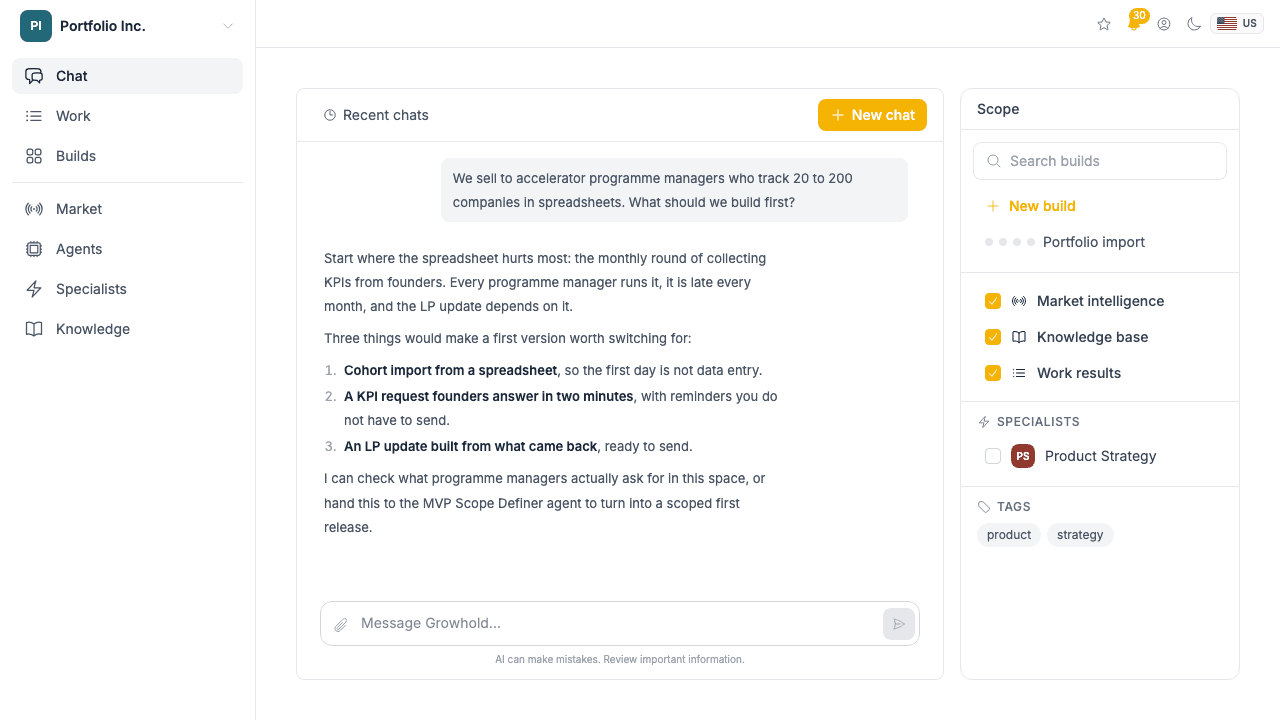
Growhold
Agents read demand signals, so the right problem is validated before anything is built.
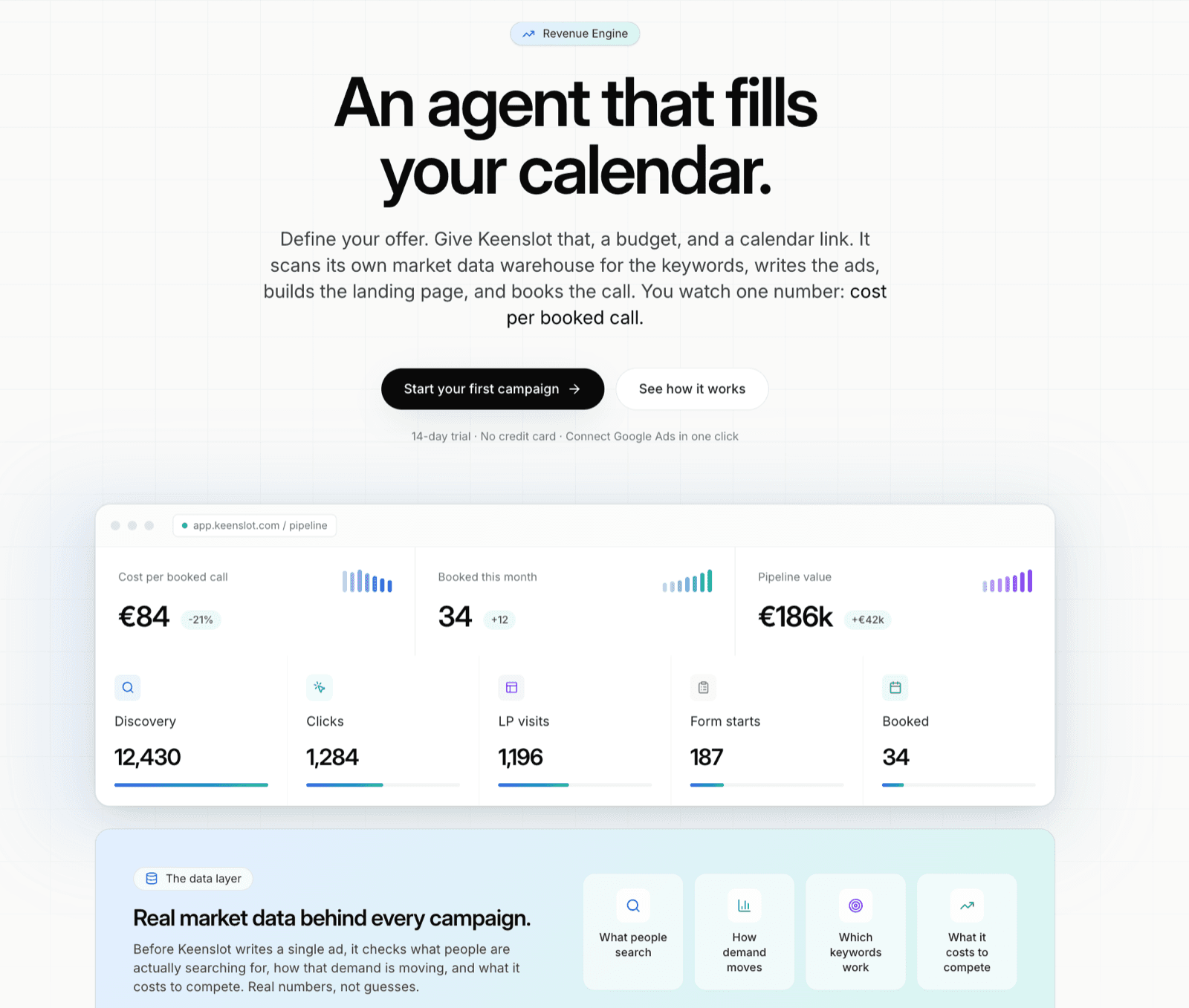
Keenslot
The agent is measured on one number customers care about: cost per booked call.
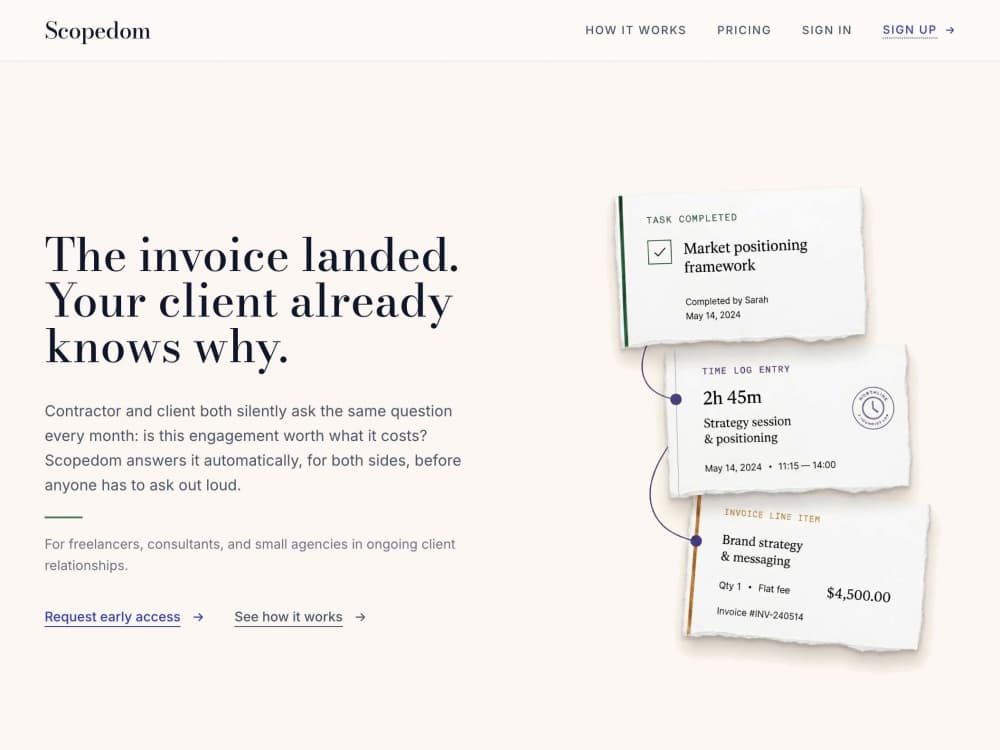
Scopedom
The record of work proves what was delivered, so the invoice is a confirmation.
My own products are validated before they are built and measured once they run.
The shift
An eval now decides what you get paid. So what counts as a good answer is your call.
Software vendors already let an eval decide whether an agent’s work counts. Zendesk bills only the resolutions an AI check verifies. HubSpot bills only the conversations its agent resolved without a person. When a check decides what the customer pays for, defining a good answer is a product decision.
What you get
The right problem. Solved right.
The right problem
ValidationThe problem worth solving
Which customer job the agent takes on, what that job costs them today and what they would pay to have it done. Checked with your customers and your data, not assumed.
What a good answer is
The acceptance criteria a product owner would write: what the agent must deliver for the answer to be worth giving, agreed by customer, sales and product.
Solved right
EvalsEvery answer evaluated
Evals on real cases score each answer against those criteria: correct, complete, safe and what it cost. Guardrails and human review where a wrong answer has consequences.
Proof everyone can read
Results your team, your customers and your sales can see, in a form that holds up at renewal and answers SOC 2 and HIPAA questions.
A product owner makes sure a SaaS team builds the right thing and builds it right. Agents need the same judgement, and evals give it evidence.
Who you work with

Fractional CTO and product lead, Vienna
I founded an enterprise SaaS company, and as product owner I made sure teams built the right thing. I build my own agent products the same way. I own the product call, the architecture and the numbers together.
Delivered within my work as Fractional CTO, Product Lead or AI Architect.
“Kristian is certainly one of the top picks in his field.”
Business value and technology, owned by one person. That is where agents succeed or fail.
- 25 years
- In software architecture and product, in Europe and North America.
- 50+
- Product launches across startups and enterprises.
- 5.0★★★★★
- Upwork rating, Top Rated Plus, more than $500K earned.
Multi-agent systems
Each agent passes its evals. The customer can still fail.
When agents hand work to each other, each one can pass its own evals while the system fails the customer. So the evals follow the whole workflow: every handoff, every permission boundary, every point where a person decides, and the audit trail behind it.
What the evals follow
Every handoff between agents: what one agent passes on is checked against what the next one needs.
Every permission boundary: an agent that proposes an action outside the plan is stopped, and a person decides. Every decision is logged and auditable.
How it works
From doubt to evidence. Validated before it scales.
The problem is checked first, then the answers. Decisions on roadmap, offer and price come last, from the numbers.
- 1
Value review
Your agents, your customers, their data and your current offer. A written problem statement, acceptance criteria and measurement plan.
- 2
Evals in place
Evals, guardrails and tracking live in your product, built with your team and the agents.
- 3
Validation with customers
The results in front of a few customers: do the agents solve their problem, and do they see it.
- 4
Decisions from the numbers
Roadmap, offer and pricing options set against what the results show.
- 5
Handover or ongoing
Your team runs the evals and the reporting, or I stay on as your fractional CTO, product lead or AI architect.
Plans
A fixed price for each step. Start with the value review.
Each plan builds on the one before it, at a fixed price agreed before the work starts. Most start with the value review and decide the next step once the numbers are on the table.
Value review
$2,900
2 weeks
Your agent, your customers and their data reviewed. A written problem statement, acceptance criteria and measurement plan.
Book a callEvals in place
Recommended$6,900
4 weeks
The value review, then evals, guardrails and tracking live in your product for one agent workflow, built with your team.
Book a callValidated with customers
$12,900
8 weeks
Evals in place, then the results in front of your customers, and roadmap, offer and pricing options set from the numbers.
Book a callMulti-agent and ongoing
Let's talk
Milestones
Multi-agent systems evaluated as one product, and your agents kept on the right problem as the product changes.
Talk it through- Your accounts
- Your data
- Written decisions
- Linear and agents configured
How it starts
Bring these to the first call.
Your answers shape the value review.
- 1
What do your agents do today, and for whom?
- 2
Which customer problem are they meant to solve, and how do you know it is the right one?
- 3
What would a customer call a good answer?
- 4
What data shows whether that answer was given?
- 5
What happens today when an agent gets it wrong?
Roles and outcomes
Delivered by one person. The roles behind the evals.
Evaluation is delivered within my fractional CTO, product lead or AI architect work. Take the role that fits, or one of the other outcomes.
SaaS & AI product launch
Agentic frame included
A SaaS or AI MVP launched for paying customers, at a fixed price, in weeks.
Enterprise AI agents
Every decision has an owner
Multi-agent workflows across your business, with human review where it matters.
AI agent evaluation
This page · Right problem, solved right
AI agents that solve the right problem, proven with evals end to end.
Fractional CTO
Technical direction you can trust
Technical direction, architecture calls and your development team, owned part-time.
Product Lead
What to build, and why
What gets built and in which order, turned into specs your team can ship.
AI Architect
AI that holds in production
AI features and agents that hold in production, with evals and permissions.
Industries
See it in your industry. A good answer depends on your field.
Each page shows where evals matter most in that industry.
- Software and SaaS companies
- Digital and marketing agencies
- Healthcare and HealthTech
- FinTech, financial services and M&A
- Real estate and PropTech
- Education and EdTech
- B2B e-commerce and wholesale
- Media and digital content
- Insurance and InsurTech
- Life sciences and regulated software
- Restaurants and hospitality
- Mobility, travel and aviation
- Government and public sector
Questions
FAQ
What does AI agent evaluation cover?
Two checks, both needed. Validation asks whether the agent solves a problem customers care about and would pay to have solved. The evals ask whether it solves that problem correctly, every time. An agent can pass its evals and still answer the wrong question.
How do you evaluate a multi-agent system?
As one product. Each agent gets its own evals, and the workflow gets evals of its own: whether each handoff carries the right information, whether every agent stays inside its permissions, where a person decides, and whether the customer gets the result they needed at the end.
How is this different from an evals tool?
A tool runs the evals. It does not decide what to measure or what the results mean for the product. That decision is the work: which problem matters, what a good answer is, and what to change when the numbers say so.
Our agent works in the demo but fails with real customers. Where do you start?
With what a good answer is for those customers, and the data that shows whether it was given. Then evals run on real cases, so every failure is caught, scored and fixed before customers see it.
Does this cover pricing?
As a consequence, not as the starting point. Once the results show what the agent delivers, the pricing options are laid out against them, so the price is one the answers can justify.
How is this priced?
At a fixed price per plan: the value review $2,900, evals in place $6,900 and validation with customers $12,900, excluding VAT. Multi-agent systems and ongoing work are scoped with you.
Get in touch
Start with a call.
We go through what your agents do today and which customer problem they should solve. You leave with a view on both questions and the next step.
Services: SaaS & AI product launchEnterprise AI agentsAI agent evaluationFractional CTOProduct LeadAI Architect